
The Cost of Being the Default
“You Used to Be Nice”: The Science Behind Resentment, Burnout, and Emotional Labor in Motherhood
“You Used to Be Nice” Why So Many Mothers Are Labeled “Mean”
“I feel like I’m mean to my partner now.”
This is one of the most common confessions I hear from women after becoming mothers — and research backs this up.
Not because they’ve changed for the worse.
But because chronic sleep deprivation, invisible labor, and lack of attunement fundamentally alter the nervous system.
Many women are told:
“You’ve changed.”
“You used to be nicer.”
“Why are you always irritated?”
“Just tell me what you need.”
On the surface, these statements seem neutral or practical.
But psychologically and physiologically, they land very differently especially in the postpartum period.
Maternal Burnout Is Real and Measurable
Research published in Frontiers in Psychology identifies maternal burnout as a distinct condition characterized by:
Emotional exhaustion
Cognitive overload
Emotional distancing
Loss of identity beyond caregiving
Burnout occurs most often when demands outweigh resources, especially when support is inconsistent or requires constant explanation.
Sleep deprivation alone has been shown to:
Increase irritability
Decrease emotional regulation
Impair empathy and desire
Lower stress tolerance
This isn’t a personality shift it’s a neurological response. Not to mention the disruption in sleep can last for years with just one child. If you add more children to the mix, we could be talking about long-term sleep deprivation, which is another animal altogether.
This Isn’t About Chores It’s About the Mental Load
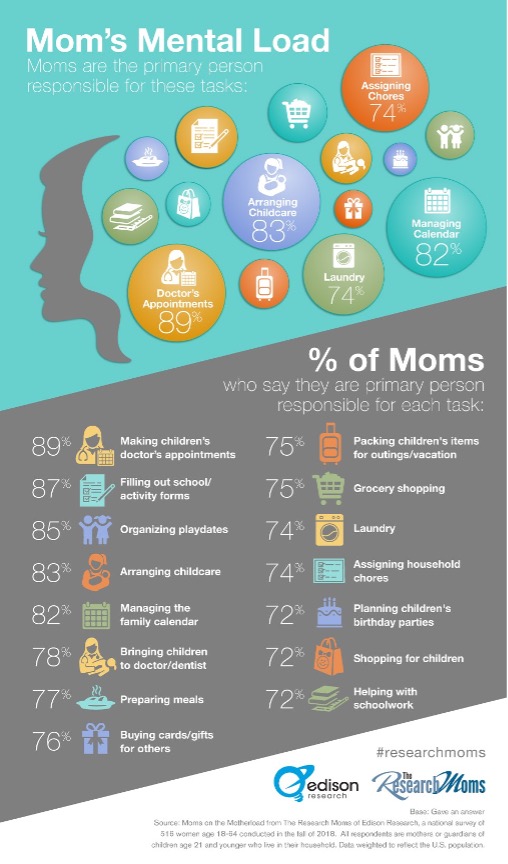
Sociologist Arlie Hochschild coined the term “emotional labor,” while later research expanded this to include the mental load — the invisible planning, tracking, anticipating, and organizing work that keeps households functioning.
Studies consistently show:
Women carry the majority of cognitive labor in heterosexual households
This disparity widens after children are born
Even when chores are “shared,” planning and management often are not
What this looks like in real life:
Remembering feeding schedules
Tracking supplies
Anticipating needs before they become emergencies
Managing the emotional climate of the household
Monitoring everyone else’s stress levels
This work is invisible but deeply depleting. Again, this work continues far past infancy stages of development. Mother’s tend to carry this “mental load” even into their children entering adulthood.
Why “Just Tell Me What You Need” Feels Invalidating
From a communication standpoint, “just tell me what you need” sounds reasonable.
From a nervous system perspective, it often feels like abandonment.
Research on relational attunement shows that emotional safety increases when partners notice needs proactively — not just reactively.
Needing to ask for:
Sleep
Water
Food
Breaks
Relief
doesn’t feel like support.
It feels like another job.
Especially when one partner gets rest automatically while the other has to advocate for survival-level needs. When a baby is first born, there is often female presence in the home that helps, grandmothers, mother-in-laws, sisters, female friends, etc. However, some people don’t have that and even those that do, usually only have it temporarily.
Resentment Isn’t Anger It’s Accumulated Invisibility
Resentment forms when effort is ongoing and unseen.
Psychological research on resentment shows it emerges when:
Contributions are unequal
Needs go unmet for extended periods
Attempts at communication are minimized or dismissed
Being told:
“It’s not a contest”
“I’m tired too”
“Work has been hard too”
may be factually true but emotionally dismissive when one person has been living in chronic depletion for months or years.
The issue isn’t comparison.
The issue is who carries the default load.

Why Desire and “Niceness” Decline After Motherhood
Neuroscience explains this clearly:
When the nervous system is in survival mode, it deprioritizes:
Desire
Playfulness
Sexual openness
Emotional generosity
Studies on female desire show it is highly responsive to:
Feeling supported
Feeling seen
Feeling relieved of responsibility
You do not get access to softness when someone is drowning.
You don’t drain someone dry and then ask why they’re no longer sparkling.
Emotional Contagion: When His Mood Becomes Your Problem
Research on emotional contagion shows that moods transfer rapidly between close partners especially when one person is already depleted.
When a woman is expected to:
Regulate the kids
Regulate the household
Regulate herself
Regulate her partner’s emotions
irritation becomes the body’s final boundary.
This isn’t cruelty.
It’s self-protection.
The Unspoken Truth About What Women Want
Most women don’t want “help.”
They want:
Initiative
Attunement
Responsibility taken without instruction
Relief that doesn’t come with a task list
Because being noticed regulates the nervous system.
And being unseen for too long doesn’t make someone mean —
it makes them guarded.
If This Resonates, You Are Not the Problem
You are not:
Bad at communication
Ungrateful
Difficult
Broken
Failing your relationship
Needing to medicate yourself somehow
You are likely over-functioning in a system that quietly expects women to absorb everything and stay pleasant while doing it.
Irritation is information.
Resentment is a signal.
Signals don’t need silencing.
They need attention.
The Question Worth Asking
If a woman “used to be nicer,”
it’s worth asking:
Who used to take care of her — and who stopped?


