Been There
Been There
What treatment communities teach us about empathy, bonding, and the friendships that actually hold.
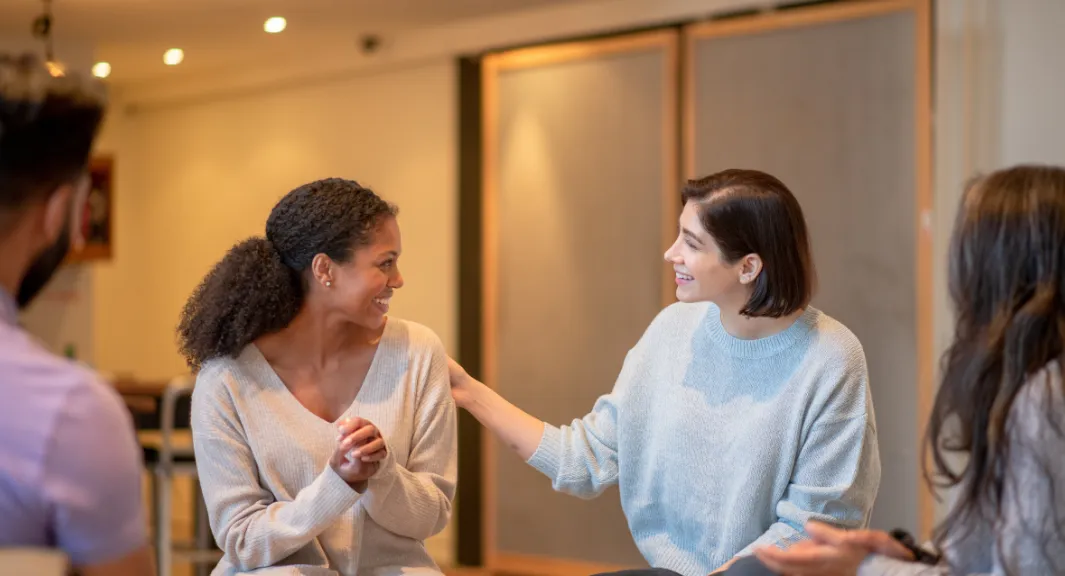
Ask almost anyone who has spent time on an inpatient unit or in an intensive outpatient program about the people they met there, and you will often hear something that surprises them in the retelling: those were some of the realest friendships I have ever had. People who had known each other for days talking with a candor it takes years to reach on the outside. A stranger noticing you had gone quiet and sitting down beside you without being asked.
It is tempting to turn that observation into a tidy inspirational claim — that people who struggle with mental illness are simply more empathetic, more open, better friends. It is a generous idea, and there is a real phenomenon underneath it. But the research tells a more interesting and more honest story than the bumper-sticker version, and the honest version is the one worth writing down.
The bonding is real — and it has been studied
This closeness is not a trick of memory or the fog of a hard week. Researchers who study peer support in psychiatric settings have documented it directly. A 2025 review of peer support on acute inpatient units found that this kind of mutual care tends to arise on its own among patients — unprompted, unstructured, and rooted in shared emotional experience. Clinicians even have a word for what is happening: mutuality, the reciprocal, non-hierarchical kind of support that only people standing on the same ground can offer each other.
And it matters to people. In some studies, patients describe the connection they found with peers as one of the most valuable parts of being hospitalized — occasionally more helpful, in their own eyes, than the care they received from professionals. A study of one psychiatric peer-support group found that simply being understood by others who had been through it built a sense of commonality and respect, and quietly chipped away at the shame people carried about their diagnoses.
The evidence is not a blank check, though, and I would be overselling it if I said otherwise. A large meta-analysis found that peer support does relatively little for what clinicians call clinical recovery — symptom reduction — while offering a modest but real boost to personal recovery: the felt sense of hope, agency, and being a person again rather than a case. These connections may not cure anyone. But they help people feel human while they heal, and that is not a small thing.
Why shared struggle opens people up
So where does the depth come from? Part of the answer is that suffering, under the right conditions, can genuinely expand a person's capacity for empathy. It sounds almost too neat, but it holds up. In one study, adults who had lived through childhood trauma scored higher on measures of empathy than those who had not — and the more severe the trauma, the stronger the effect.
Social psychologists have a name for the broader pattern: altruism born of suffering, the documented tendency for people who have been through hardship to become more motivated to help others who are hurting — sometimes even strangers, or people well outside their own group. In one experiment, the more adversity people had faced, the more compassion they reported, and the more of their own money they actually gave away to people in need.
This is the been-there effect made literal. When you have been at the bottom, you recognize the look on someone else's face when they are there too. You are harder to shock. You have lost the luxury of pretending certain things do not happen to people — which turns out to be the same luxury that lets people stay judgmental. Losing it is exactly what makes someone easy to talk to.
Where the feel-good version gets it wrong
Here is where I want to be careful, because this is where a good idea usually gets oversold. It is true that struggle can deepen empathy. It is not true that struggle reliably makes people kinder, or that having a mental illness makes someone a better friend. The same researchers who study altruism born of suffering are blunt about the other half of the picture: suffering is not inherently good or automatically transformative, and adversity just as often breeds withdrawal, bitterness, or harm as it does compassion. Growth is one possible road out of pain — not a toll that pain reliably pays.
There is also a quieter complication. Empathy has a shadow side that clinicians see constantly: personal distress, the version of empathy where someone else's pain floods you instead of moving you toward them. It shows up more in depression, and it does not build friendships — it drives guilt, avoidance, and the kind of over-giving that burns a person out. So "more empathetic" is not automatically "better friend," and it is not evenly distributed. Mental illness can isolate a person as easily as it can connect them. For many people, the loneliness is the illness.
And "people with mental illness" was never one kind of person to begin with. It is a category spanning wildly different conditions, some of which shape social connection in opposite directions. A warm generalization is still a generalization — and the flip side of "you are all so empathetic" is "you are all the same," which is the exact move that stigma runs on.
It was never about being sick
So if it is not the illness that makes those treatment-center friendships so real, what is it?
It is the conditions. On a unit or in a group room, the usual scaffolding of social performance is simply gone. Everyone already knows why everyone else is there. Nobody is curating. The pretense that costs so much energy on the outside — I'm fine, I've got it handled — gets dropped out of necessity, and what rushes into the space it leaves is honesty, and then, quickly, intimacy. People are not better friends there because they are sick. They are better friends there because they have stopped hiding, at the same time, in the same room, with people who have agreed not to flinch.
That is the part worth carrying back out. The closeness people find in treatment is not proof that suffering ennobles, or that some people are simply born more compassionate. It is proof of something more useful: that dropped armor and shared honesty build the friendships that actually hold — and that most of us walk around far more armored than we need to be. You do not have to have been hospitalized to offer someone the thing that makes those bonds. You just have to be willing to stop performing, and to not flinch when someone else does first.
Been there is not a diagnosis. It is a posture. And it is available to anyone willing to take it.
Sources & further reading
“Peer support in acute psychiatric inpatient settings: A scoping review” (2025), Psychiatry and Clinical Neurosciences Reports.
“The role of peer support in recovery among clients with mental illness attending the psychiatric service in a tertiary hospital” (2024), qualitative study.
“The Effectiveness of Peer Support in Personal and Clinical Recovery: Systematic Review and Meta-Analysis,” Psychiatric Services.
“Elevated empathy in adults following childhood trauma” (2018), PLOS ONE.
Staub, E., & Vollhardt, J. (2008), “Altruism born of suffering,” American Journal of Orthopsychiatry.
Lim, D., & DeSteno, D. (2016), “Suffering and compassion,” Emotion.


