
The Power of Multiple Intelligences
More Than One Way to Be Smart
A plain-language guide to the different types of intelligence — and why the question “am I smart?” was the wrong question all along.
Somewhere along the way, most of us absorbed a quiet, limiting idea: that intelligence is one thing, that you either have it or you don’t, and that a single test score can sum it up. It is a tidy story. It is also wrong — and the version of it we carry around often does real damage. People decide early that they are “not smart” because school measured one narrow slice of what their mind can do, and they spend years living inside that verdict.
The truth is more generous. Intelligence is not a single trait you have a fixed amount of. It is a collection of different capacities, and most people are far stronger in some areas than others. Knowing the difference can change how you understand yourself, how you parent, how you work, and how kindly you talk to yourself when something doesn’t come easily.
Where the “one-number” idea came from
The familiar measure is IQ — the intelligence quotient. It grew out of early-1900s efforts to predict how children would do in school, and it still does a reasonable job of that. IQ tests capture things like verbal reasoning, working memory, and processing speed, and those abilities matter.
The problem isn’t that IQ measures nothing. It’s that it was never meant to measure everything — and we let it. A score on a timed test of logic and language says little about whether you can read a room, calm yourself under pressure, build something with your hands, or move through the world with rhythm and grace. Plenty of people who struggled in a classroom are deeply intelligent in ways that classroom never looked at.
Howard Gardner and the many ways of being smart
In 1983, psychologist Howard Gardner proposed a different model: the theory of multiple intelligences. Instead of one general ability, he described several relatively independent ones, each with its own kind of “smart.” His framework caught on, especially with educators, because it matched something people already sensed — that a child who can’t sit still and memorize might be brilliant on a stage, a field, or a workbench.
Here are the eight intelligences Gardner is best known for:
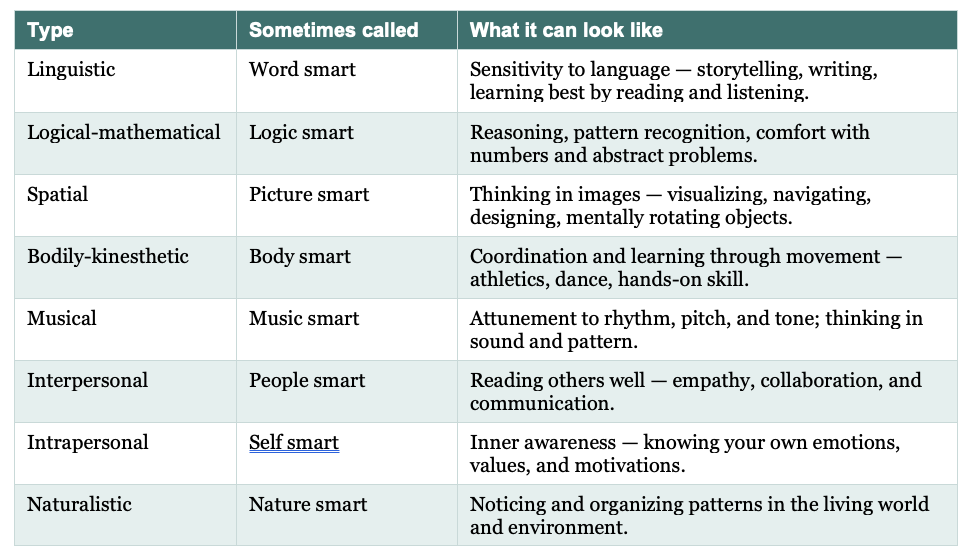
Gardner later discussed a possible ninth — existential intelligence: a pull toward the big questions of meaning, mortality, and our place in the universe. He treated it cautiously, and it remains the most debated of the set, but many people recognize it instantly in themselves.
Emotional intelligence: the kind that quietly runs your life
If there’s one form of intelligence worth singling out, it’s emotional intelligence — often shortened to EQ. Popularized by psychologist Daniel Goleman, it’s the ability to recognize, understand, and work skillfully with emotions, both yours and other people’s. It tends to predict relationship quality, leadership, and day-to-day wellbeing better than raw IQ does.
It’s usually broken into four parts:
•Self-awareness — noticing what you feel as you feel it, instead of being run by emotions you can’t name.
•Self-management — staying steady under stress and choosing your response rather than reacting on autopilot.
•Social awareness — picking up on what others are feeling, including the things they aren’t saying out loud.
•Relationship management — using all of the above to communicate, repair conflict, and connect.
Here’s the part that matters most clinically: unlike IQ, emotional intelligence is genuinely teachable. It’s a set of skills, and skills can be practiced. Much of therapy is, in a sense, EQ training — learning to feel your feelings without drowning in them, to read your own nervous system, and to stay connected to people when it’s hard.
A fair word about the science
Honesty matters here. Gardner’s multiple intelligences is one of the most influential ideas in education, but it’s also one of the most debated. Some researchers argue that what he calls separate “intelligences” are better described as talents or abilities, and that the theory hasn’t held up to the kind of statistical testing that supports a single, general intelligence factor.
That critique is worth knowing. But it doesn’t cancel out the practical value of the idea — and the framework that has held up to research, emotional intelligence, points in the same human direction: intelligence is broader, more varied, and more changeable than a single score ever suggested. Whether you call them intelligences, abilities, or strengths, the point stands.
Why this matters for your mental health
This isn’t just trivia about how minds work. The single-number story does quiet, lasting harm. When someone believes intelligence is one fixed thing they lack, they stop trying, they shrink their world, and they treat themselves with a contempt they’d never aim at a friend.
Widening the definition gives you something back. It lets you locate your actual strengths instead of measuring yourself against the one yardstick that happened to be in the room. It makes room for the kid who learns with their body, the adult who thinks in pictures, the person whose gift is sensing what a room needs. And it reframes the parts that come hard — not as proof you’re “not smart,” but as areas that simply aren’t your strongest, which is true of every human who has ever lived.
A few questions worth sitting with
•Which of these intelligences do you reach for without thinking — and where in your life does it show up?
•Which one did school or family quietly teach you to dismiss in yourself?
•If “being smart” included all of these, where would you actually rank — and how does that land?
If reading this stirred up an old story about not being “smart enough,” that’s worth paying attention to — those verdicts usually got handed to us young. At Personal Wellness Solutions, we help people unlearn the narratives that have been quietly running the show and reconnect with their real strengths. Reach out anytime at mypersonalwellnesssolutions.com.


