
The Path Back to Your Body
Out of Your Head and Into Your Body
A clinically grounded, step-by-step guide to coming back to yourself
If you live mostly in your thoughts, you already know the loop. You replay the conversation. You rehearse the one that hasn’t happened yet. You analyze your feelings instead of feeling them. The mind is working hard — and somewhere below your neck, the rest of you has gone quiet, or numb, or tense in ways you stopped noticing a long time ago.
Being “stuck in your head” isn’t a character flaw or a sign that you think too much. For most people, it’s a learned strategy. At some point, staying up in the control tower of the mind felt safer than dropping down into the body, where the harder sensations live. The good news: the path back is trainable. Below is a clinical look at why this happens and a practice you can actually use, followed by journal prompts to take it deeper.
Why We Leave the Body in the First Place
When we’re anxious, overwhelmed, or carrying old stress, the brain leans on what it does best: thinking, predicting, controlling. Rumination and worry feel productive because they keep us in the part of ourselves that has language and a sense of control. The body, by contrast, holds the raw material — the tight chest, the clenched jaw, the flutter of dread — and that can feel like too much. So we float up and out.
This shows up clinically as disrupted interoception — the sense that tells you what’s happening inside your own body (hunger, heartbeat, breath, tension, the early signal of an emotion). People who run hot on anxiety or who have lived through trauma often have a foggy or unreliable interoceptive signal. You may not notice you’re activated until you’re already overwhelmed, or you may feel “nothing” until the body forces the issue through a headache, a stomachache, or a crash.
The Clinical Why: You Can’t Think Your Way Calm
Polyvagal theory, developed by Dr. Stephen Porges, gives us a useful map. Your autonomic nervous system is constantly scanning for cues of safety and danger — a process he calls neuroception — well beneath conscious awareness. When it reads safety, you’re in a settled, socially open state. When it reads threat, it mobilizes you (anxiety, irritability, the urge to flee or fix) or shuts you down (numbness, fog, disconnection). The key point: this happens in the body first, and the thinking brain gets the memo second.
Dr. Dan Siegel calls the settled zone the window of tolerance — the band of arousal where you can think clearly and feel your feelings at the same time. Outside that window, in overwhelm or shutdown, the reasoning brain goes partly offline. This is why “just calm down” and “stop overthinking” never work. You cannot use a dysregulated brain to talk itself out of dysregulation.
What does work is bottom-up regulation: sending the nervous system signals of safety through the body — breath, movement, the senses, orientation to your surroundings — so the thinking brain can come back online. Getting into your body isn’t a soft add-on to the “real” work. Physiologically, it is the work.
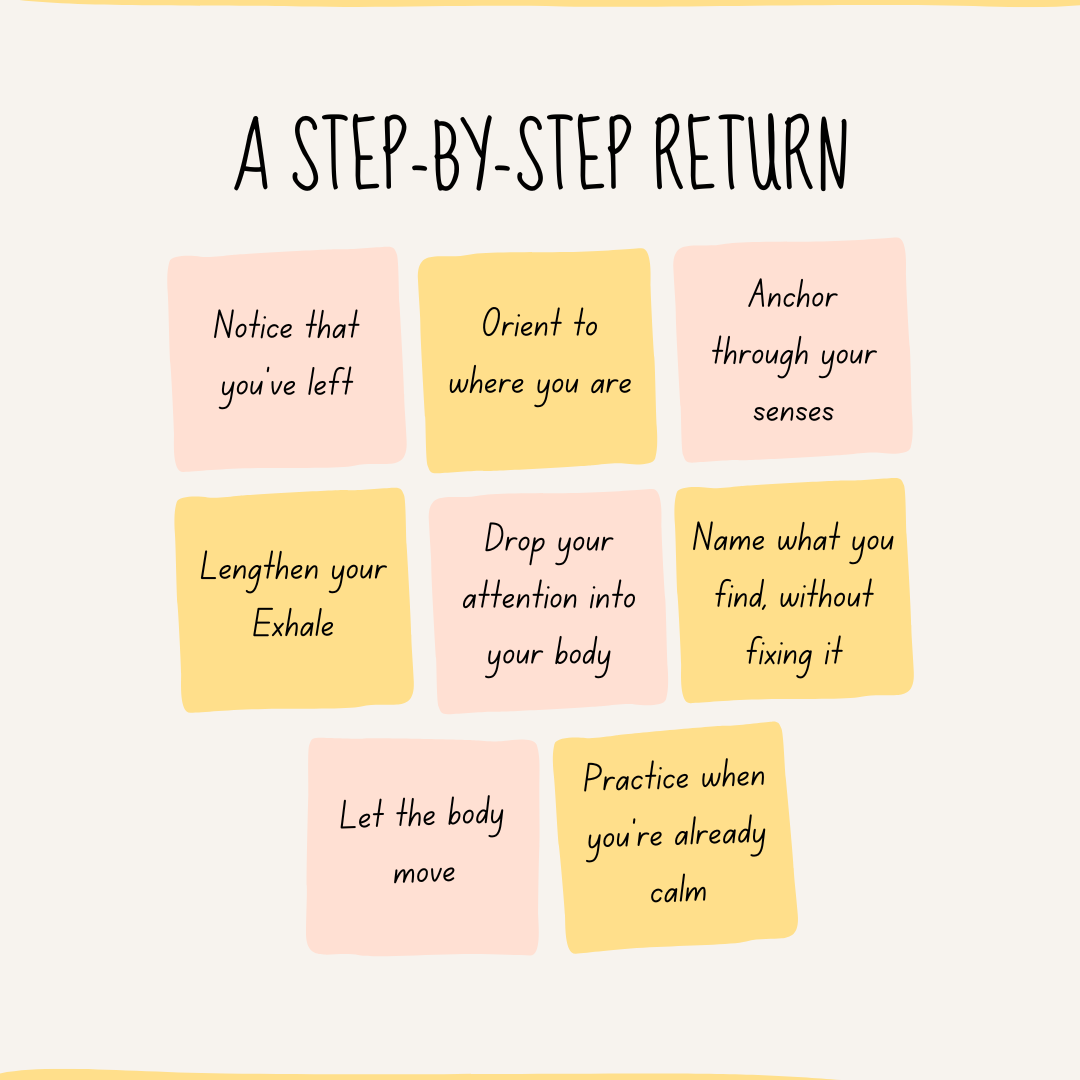
The Practice: A Step-by-Step Return
Think of this as a sequence, not a checklist to perfect. Move through it slowly. If a step feels like too much, ease off and stay with an earlier one — there’s no prize for pushing past your window.
Step 1Notice that you’ve left.
Awareness comes first. Name it plainly, even silently: “I’m up in my head right now.” Naming the state is itself a small act of returning — it puts a sliver of the observing mind back in contact with the present. Look for your personal tells: a tight jaw, shallow breathing, a racing list, the sense of watching your life from behind glass.
Step 2Orient to where you are.
Slowly turn your head and let your eyes move around the room. Notice three things that tell you you’re here and safe right now — the light, a color, the door, the ground under you. This engages the orienting reflex, a built-in cue to the nervous system that the environment is being checked and there’s no immediate threat. Let your gaze land on something pleasant and rest there for a breath or two.
Step 3Anchor through your senses.
Drop down out of thinking by flooding the channel with sensory input. The classic 5-4-3-2-1 works because it’s hard to ruminate and catalog your senses at the same time: name five things you can see, four you can hear, three you can touch, two you can smell, one you can taste. Touch is especially grounding — feel the texture of your clothing, the temperature of the air, your feet inside your shoes.
Step 4Lengthen your exhale.
Breathe in for a count of about four, then out for a count of six or more. The extended exhale is one of the most direct levers you have on the vagus nerve and the parasympathetic “brake” — it tells the body the emergency is over. Do this for five or six rounds. Don’t force a big inhale; the slow, long out-breath is where the regulation happens.
Step 5Drop your attention into your body.
Now that the system has settled a notch, you can sense inward without being flooded. Move your attention slowly from your feet upward — feet, legs, belly, chest, shoulders, jaw — and simply notice what’s there. Pressure, warmth, tightness, buzzing, nothing at all. You’re not trying to change anything yet. This is interoception, and like any sense, it sharpens with practice.
Step 6Name what you find, without fixing it.
Put words to the sensation and, if you can, the feeling underneath it: “Tightness in my chest. I think that’s anxiety.” This is affect labeling, and research shows that naming an emotion reliably lowers activity in the brain’s alarm center. The instinct will be to analyze or solve. Resist it. The goal here is to feel and name, not to explain. Sensations that are allowed to be felt tend to move and soften on their own.
Step 7Let the body move.
Energy that’s named often wants to discharge. Give it somewhere to go: roll your shoulders, shake out your hands, stretch tall, press your feet into the floor, take a short walk, sway. You’re completing the physical cycle the nervous system started. Even thirty seconds of intentional movement helps the activation finish moving through rather than getting stored.
Step 8Practice when you’re already calm.
This is the step almost everyone skips. Don’t wait for a crisis to find the door. Run a shortened version — a few orienting glances, a few long exhales, a quick body scan — once or twice a day when nothing is wrong. You’re building a neural pathway through repetition, so that under stress the route back to your body is familiar instead of brand new. Regulation is a skill, and skills are built in the easy moments.
A Few Honest Notes
•Start small. Sixty seconds done daily beats a twenty-minute practice you do once and abandon.
•Numbness is information, not failure. If you scan your body and feel nothing, that’s a meaningful signal worth getting curious about — gently.
•If dropping into the body brings up too much — panic, flooding, dissociation — that’s a sign to slow down and, ideally, to do this work with a trauma-informed therapist who can help you stay inside your window of tolerance.
Journal Prompts: Going Deeper
Use these after the practice, when your system is a little more settled. Write by hand if you can — it’s slower, and slower is the point. There are no right answers.
1.Where do I most often “live” in my body — in my head, my chest, my gut, or somewhere I rarely visit? What does that part of me hold?
2.When did I first learn that staying in my head felt safer than being in my body? What was happening then?
3.What sensation shows up most when I’m anxious, and what is it usually trying to tell me before I think my way past it?
4.What does my body feel like in a moment of genuine safety or ease? Can I describe it in detail so I’d recognize it again?
5.Which of the eight steps felt easiest, and which one did I want to skip? What might the resistance be protecting?
6.If my body could speak in plain language right now, what would it say it needs from me today?
7.What’s one small, repeatable way I can check in with my body tomorrow — before I’m in distress?
Coming home to your body is not a one-time arrival — it’s a practice of returning, again and again. Every time you notice you’ve left and find your way back, you’re teaching your nervous system that it’s safe to be here. That’s the whole work, and you can begin it today.
Personal Wellness Solutions·Virtual & in-person counseling in Florida·mypersonalwellnesssolutions.com
This article is for education and self-reflection and is not a substitute for individualized mental health care.


