Who Are You Really? Exploring the Layers of Identity
Who You Are: The Existence System
A practical, psychologically informed model with self‑reflection questions
Introduction
A person’s identity doesn’t come from just one place. It’s built through layers of behavior, thought, emotion, memory, and meaning.
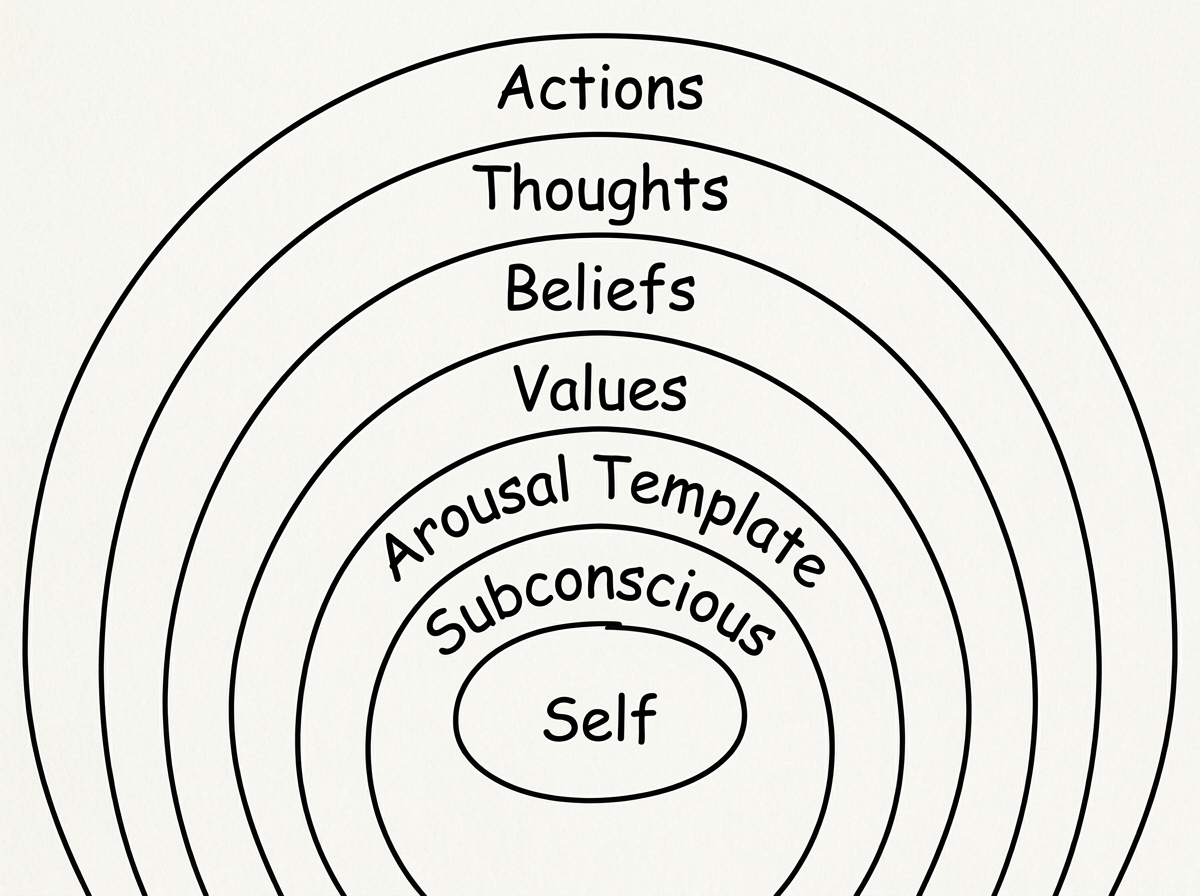
The “Existence System” is a useful way to understand those layers — starting from your actions and moving all the way up to your sense of self.
Although this model isn’t an official diagnostic tool, each layer aligns with concepts found in cognitive‑behavioral therapy (CBT), acceptance‑based therapies, schema therapy, and modern neuroscience.
Use this guide to understand how your internal system works — and to ask better questions about who you are and who you want to become.
1. Actions
Your actions are the visible outputs of your internal system.
They represent real‑world choices shaped by what’s happening beneath the surface.
Examples:
showing up late
avoiding a hard conversation
taking a risk
practicing a new skill
Why this layer matters
Behavioral psychology consistently shows:
Behavior changes neurobiology, emotion, and belief faster than thought alone.
Self‑reflection questions
What actions do I take that don’t match the person I want to be?
Where do my actions already reflect my values?
What small behavior, repeated daily, would change my direction the most?
2. Thoughts
Thoughts are interpretations, predictions, and mental commentaries.
In CBT, these are called “cognitive distortions,” “automatic thoughts,” or “appraisals.”
Examples:
“I’m going to fail.”
“They probably don’t like me.”
“I know I can figure this out.”
Why this layer matters
Thoughts influence behavior, but they are not facts.
Learning to observe them instead of obeying them is a key therapeutic skill.
Self‑reflection questions
What thought keeps showing up during stress?
Which thoughts help me — and which ones hurt me?
If a friend had this thought, what would I tell them?
3. Beliefs
Beliefs are thoughts repeated so often they become conclusions.
They shape what you expect from yourself and the world.
Types of beliefs:
Core beliefs (e.g., “I’m unlovable,” “I’m capable”)
Intermediate beliefs (rules, assumptions, shoulds)
Conditional beliefs (“If I don’t succeed, I’m a failure”)
Why this layer matters
Beliefs act like filters. They determine what thoughts you generate and what evidence you notice.
Self‑reflection questions
What belief about myself has been with me the longest?
Which belief no longer fits who I am becoming?
What belief do I want to strengthen?
4. Values
Values are your internal compass.
They represent what genuinely matters to you — not what you think should matter.
Common values include:
growth
connection
creativity
autonomy
stability
contribution
Why this layer matters
When your actions violate your values, psychological distress increases.
When your life aligns with your values, motivation becomes sustainable.
Self‑reflection questions
What value do I honor most consistently?
What value have I been neglecting?
If I lived 10% more in alignment with my values, what would change?
5. Arousal Template
This layer describes your emotional activation patterns and nervous system wiring.
It includes what you’re drawn to, alarmed by, soothed by, or triggered by.
Influenced by:
childhood attachment
trauma history
repetition of emotional experiences
learned safety and learned danger
modeling from caregivers
Why this layer matters
Your arousal template shapes:
conflict responses
attraction and relationship patterns
comfort zones
motivation and anxiety cycles
emotional thresholds
This is where many “stuck” patterns live.
Self‑reflection questions
What situations activate me the fastest?
What emotional patterns feel familiar, even if they’re unhealthy?
What environments help my system feel safe?
6. Subconscious
The subconscious stores memories, emotional associations, learned patterns, and identity‑protective mechanisms.
It runs processes such as:
habit formation
emotional memory
threat detection
self‑concept preservation
implicit assumptions about the world
Why this layer matters
Much of your behavior happens automatically.
Changing your subconscious patterns often requires repeated action, emotional work, or identity shifts — not just rational understanding.
Self‑reflection questions
What do I do automatically without thinking?
What patterns feel like they “just happen” to me?
What unconscious rules did I inherit from family or culture?
7. Identity
Identity is your internal answer to the question:
“Who am I?”
Your identity determines:
what beliefs you allow
which values you prioritize
how your arousal system reacts
how you interpret experiences
which actions feel natural or unnatural
Identity work involves redefining the story you tell yourself about yourself.
Why this layer matters
Identity is the most powerful lever for change.
When identity shifts, the entire system reorganizes.
Example:
Going from “I’m someone who struggles” to “I’m someone who grows through challenges” changes thoughts, behaviors, and emotions.
Self‑reflection questions
Who have I been taught to believe I am?
Who have I decided I am?
Who am I becoming?
What identity would make my current challenges easier to navigate?
Putting It All Together
Here’s the full sequence:
Actions
→ Thoughts
→ Beliefs
→ Values
→ Arousal Template
→ Subconscious
→ Identity
Each level influences the next — but change is possible from any point.
Behavior can reshape the subconscious
Identity change can transform beliefs
Emotional regulation can rewrite your arousal template
New values can lead to new actions
Challenging beliefs can change thoughts
The system is dynamic, not fixed.
Reflection
If you want to work on your identity, start by asking:
Which layer currently feels the most active or problematic?
Which layer is easiest for me to influence right now?
Who do I want to become — and which layer needs attention first?
Transcendence
Spiritual elevation often invites a shift beyond the constructed layers of identity — even beyond the idea of “Self” at the center. Many contemplative traditions teach that when you quiet the layers of thought, belief, and memory, what remains is an open awareness that doesn’t need to hold on to a fixed identity. From that place, life feels less like something to control and more like something to move with. Letting go of the tight grip on “who I am” creates space for flexibility, compassion, and presence. Instead of defending a self, you begin to experience yourself as part of a larger flow — able to respond, adapt, and grow with far less friction.
Journal options:
When do I feel most connected to something larger than my individual identity?
What parts of my self‑story feel heavy or limiting — and what might it feel like to loosen my grip on them?
How does my life change when I allow myself to respond to the moment instead of protecting an identity?
What practices help me feel more open, grounded, or guided rather than controlled by my ego?
In what areas of my life could I experiment with more flow and less self‑pressure?


